Who Is Santa Claus?
(This post is still a work in progress.)
According to Religion Wiki, "Santa Claus, a jolly old man with a long white beard who is said to distribute presents to good children on Christmas Eve, is largely based on Odin, merged with the Christian legend of Saint Nicholas of Myra.[15] Most Christmas traditions in Germanic countries derive from celebrations of the pagan winter solstice holiday Yule as a result of the gradual merging of the two holidays.
Odin was recorded as leading a great Yule hunting party through the sky.[16] Two books from Iceland, the Poetic Edda, compiled in the 13th century from earlier sources, and the Prose Edda, written in the 13th century by Snorri Sturluson, describe Odin as riding an eight-legged horse named Sleipnir that could leap great distances, giving rise to comparisons to Santa Claus's reindeer.[17] Further, Odin was referred to by many names in Skaldic poetry, some of which describe his appearance or functions; these include Síðgrani,[18] Síðskeggr,[19] Langbarðr,[20] (all meaning "long beard") and Jólnir[21] ("Yule figure").
According to Phyllis Siefker, children would place their boots, filled with carrots, straw, or sugar, near the chimney for Odin's flying horse, Sleipnir, to eat. Odin would then reward those children for their kindness by replacing Sleipnir's food with gifts or candy. This practice, she claims, survived in Germany, Belgium, and the Netherlands after the adoption of Christianity and became associated with Saint Nicholas as a result of the process of Christianization and can be still seen in the modern practice of the hanging of stockings at the chimney in some homes."
"Thor, who was honoured as the highest god in Norway"
Thor can revive animals,
"Their host was hospitable but very poor, and Thor, seeing that he would scarcely be able to supply the necessary food to satisfy his by no means small appetite, slew both his goats, which he cooked and made ready to eat, inviting his host and family to partake freely of the food thus provided, but cautioning them to throw all the bones, without breaking them, into the skins of the goats which he had spread out on the floor. ... On the morrow, however, Thor, ready to depart, struck the goat skins with his hammer Miölnir, and immediately the goats sprang up as lively as before, except that one seemed somewhat lame."
Wore a belt,
"Seizing an opportunity to tighten his belt Megin-giörd"
Wore red clothing according to the painting Thor und die Midgardsschlange (1905) by Emil Doepler,

And had a beard and long hair according to Thor wades rivers while the rest of the æsir ride across the bridge Bifröst as described in Grímnismál (1895) by Karl Gjellerup

Thor rode in a "brazen chariot drawn by two goats".
Odin owned a horse called Sleipnir
"Odin himself was once dashing through the air on his eight-footed steed Sleipnir"
that was gray,
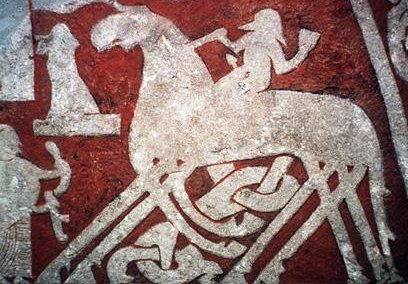
Thor's name gave rise to Thursday,
"Thor’s name has been given to many of the places he was wont to frequent, such as the principal harbour of the Faroe Islands, and to families which claim to be descended from him. It is still extant in such names as Thunderhill in Surrey, and in the family names of Thorburn and Thorwaldsen, but is most conspicuous in the name of one of the days of the week, Thor’s day or Thursday."
"Thor was considered a pre-eminently benevolent deity, and it was for that reason that he was so widely worshipped and that temples to his worship arose at Moeri, Hlader, Godey, Gothland, Upsala, and other places, where the people never failed to invoke him for a favourable year at Yule-tide, his principal festival. It was customary on this occasion to burn a great log of oak, his sacred tree, as an emblem of the warmth and light of summer, which would drive away the darkness and cold of winter."
Yule-tide, also known as Yule, according to Wikipedia is "a winter festival and time of the year historically observed by pagan Germanic peoples that was later merged with the festival of Christmas".
"Brides invariably wore red, Thor’s favourite colour,"
Thor was said to come by the houses and eat food during the night,
"Thor’s temples and statues, like Odin’s, were fashioned of wood, and the greater number of them were destroyed during the reign of King Olaf the Saint. According to ancient chronicles, this monarch forcibly converted his subjects. He was specially incensed against the inhabitants of a certain province, because they worshipped a rude image of Thor, which they decked with golden ornaments, and before which they set food every evening, declaring the god ate it, as no trace of it was left in the morning."
According to Adam of Bremen's Gesta Hammaburgensis 26, Tschan's translation (1080), Uppsala used to have a temple dedicated to paganism. "In this temple, entirely decked out in gold, the people worship the statues of three gods in such wise that the mightiest of them, Thor, occupies a throne in the middle of the chamber; Wotan and Frikko have places on either side. The significance of these gods is as follows: Thor, they say, presides over the air, which governs the thunder and lightning, the winds and rains, fair weather and crops. The other, Wotan—that is, the Furious—carries on war and imparts to man strength against his enemies. The third is Frikko, who bestows peace and pleasure on mortals. His likeness, too, they fashion with an immense phallus."
Odin himself was also depicted as an old man with a long white beard in this George Von Rosen depiction of 1886,

The Bible mentions the tradition of the Christmas tree specifically in Jeremiah 10:3-4, "For the customs of the people are vain: for one cutteth a tree out of the forest, the work of the hands of the workman, with the axe. They deck it with silver and with gold; they fasten it with nails and with hammers, that it move not."